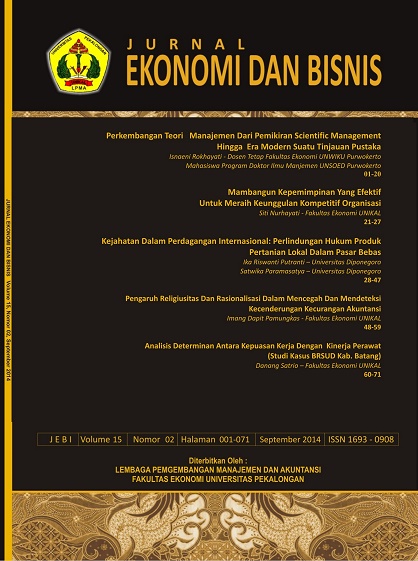
PERKEMBANGAN TEORI MANAJEMEN DARI PEMIKIRAN SCIENTIFIC MANAGEMENT HINGGA ERA MODERN SUATU TINJAUAN PUSTAKA
DOI:
https://doi.org/10.31941/jebi.v15i2.227Abstract
This paper is a review of the literature or a summary of a variety of management science movement of thought that emerged from the era of the industrial revolution, namely scientific management to today's modern era. The method used in this paper is a review of the literature or literature review with management science thinking. In this study the movement of thought in management science can be grouped into five areas of thought or theory. This is the fifth thought Scientific Management Theory, Administrative Management Theory, Behavioral Management Theory, Quantitative Management Theory, and Modern Management Theory. Of its development in the modern era in the management science can also be divided into three approaches, namely Contingency approuch (situation approach), System approuch, and Dynamic Engagement approuch. The movement of thought presented by the emergence of the idea that first appeared and followed another movement, although in the era of an emerging movement of thought could have another thought. The results of the study and review of the literature review of the literature shows that the development of management thinking starts from the idea of the technical and productivity in manufacturing and developing the ideas associated with nature and human behavior and the relationship between man and sisitem organization. In this paper the study also found an underdeveloped thoughts on the development of business management issues, the management of marketing, financial management, and strategic management. Keywords : development, Scientific management , modern management, contingency approach, system approach, dynamic approach to engagement.References
Alston, W. P. (1990). Externalist theories of perception. Philosophy and Phenomenological Research, 51(Fall), 73–97.
Alston,W. P. (1991). Perceiving God: The epistemology of religious experience. Ithaca: Cornell University Press.
Alston, W. P. (1993). The reliability of sense perception. Ithaca: Cornell University Press.
Alston, W. P. (1999). Back to the theory of appearing. Philosophical Perspectives, 13(Oct), 181–203.
Alston,W. P. (2002). Sellers and the myth of the given. Philosophy and Phenomenological Research, 65(1),69–86.
Clark, A. (1997). Being there: Putting brain, body, and world together again. Cambridge, MA: The MIT Press.
Deacon, T. W. (1997). The symbolic species: The co-evolution of language and the brain. New York: W.W. Norton & Company.
Dennett, D. C. (2005). Sweet dreams: Philosophical obstacles to a science of consciousness. Cambridge, MA: The MIT Press.
Dewey, J. (1958). Experience and nature. New York: Dover Publications.
Gibson, J. J. (1986). The ecological approach to visual perception. Hillsdale, NJ: Lawrence Erlbaum Associates.
Grimes, J. (1996). On the failure to detect changes in scenes across saccades. In K. Akins (Ed.), Perception (pp. 89–109). New York: Oxford University Press.
Hardin, C. L. (1986). Color for philosophers: Unweaving the rainbow. Indianapolis: Hackett Publishing.
Hume, D. (2000). A treatise of human nature. New York: Oxford University Press.
Jackson, F. (1986). What Mary didn’t know. Journal of Philosophy, 83(5), 291–295.
James, W. (1890). Principles of psychology (2 vols). New York: Henry Holt.
Kant, I. (1929). Critique of pure reason (trans: Smith, N. K). London: Macmillan.
Noë, A. (2004). Action in perception. Cambridge, MA: The MIT Press.
Reed, E. S. (1996). Encountering the world: Toward an ecological psychology. New York: Oxford University Press.
Skarda, C. A. (1999). The perceptual form of life. Journal of Consciousness Studies, 6(11–12), 79–93.
Varela, F. J., Thompson, E., & Rosch, E. (1991). The embodied mind: Cognitive science and human experience. Cambridge, MA: The MIT Press.
Whitehead, A. N. (1959). Symbolism: Its meaning and effect. New York: Macmillan Company.
Bolman, L.G & Deal, T.E. (1991). Reframing Organizations: Artistry, Choice, and Leadership,Jossey-Bash Publishers, San Francisco.
Degeling, P., (1997).Management and Organization School of Health Service Management, UNSW.
Morgan, G., (1997).Image of Organization, Sage Publication, California.
Sutarto.(1995). Dasar-Dasar Organisasi, Gajah Mada University Press, Yogyakarta.
Pugh, D.S. & Hickson, D.J.(1989). Writers on Organizations, Penguin Books, London.
Handy, C.B.(1986). Understanding Organization, Penguin Books, London.
Burrell, G. & Morgan, G.(1979). A Contingency Model of Organizational Analysis in ‘Sociological Paradigms and Organizational Analysis’, Gower Publishing Aldershot,
Worsley, P. (1991).The New Modern Sociology Readings, Penguin Books, London.
Giddens, A.,(1981). Agency, Institution, and Time-Space Analysis, in K. Knorr-Cetina & A.V. Circourel (Rds), Advances in Social Theory and Methodology, Routledge & Kegan Paul, London.
Setiawan, S. (1991).Theory of Everything, Andi Offset, Yogyakarta,
Quinn, dkk.(2000). Menjadi Seorang Manajer Yang Ahli (Terjemahan), Interaksara, Batam,
Ansoff, H.I., 1965, Corporate Strategy: An Analytic Approach to Business Policy for Growth and Expansion, McGraw-Hill, New York.
Argyris, C., 1970, Intervention Theory and Method:A Behavioral Science View, Addison-Wesley, Reading, USA.
Barnard, C., 1938,The Functions of the Executive, Harvard University Press, Cambridge, MA.
Chandler, A.D., 1962, Strategy and Structure, MIT Press, Cambridge, MA,
Crosby, P.B., 1979 Quality Is Free: The Art of Making Quality Certain, McGraw-Hill, New York,
Deming, W.E., 1982, Out of Crisis, MIT Center for Advanced Engineering Study, Cambridge,MA,
Drucker, P., 1954 The Practice of Management, Harper & Row, New York.
Gabor, Andrea dan Mahoney, James, 2010 Chester Barnard and the Systems Approach to NurturingOrganizations,www.businessillinois.edu, working paper.
Gilbreth, F.B. dan Gilbreth, L.M., 1917, Applied Motion Study, Sturgis and Walton, New York,USA.
Griffin, R.W.,1990, Management, edisi 3., Houghton Mifflin, Boston, MA, USA.
Herzberg, F., 1966, Work and the Nature of Man,World Press, Cleveland.
Higgins, J.M., 1991, The Management Challenge: An Introduction To Management, Macmillan, New York.
Juran, J.M., 1988, Juran on Planning for Quality, The Free Press, New York.
Koontz, H., 1961 “The management theory jungle”, Journal of the Academy of Management,
McGregor, D., 1960 The Human Side of Enterprise,McGraw-Hill, New York.
McClelland, D., 1961, The Achieving Society, Van Nostrand, Princeton, New Jersey.
Maslow, A., 1943, “A theory of motivation”, Psychological Review,
Mintzberg, H., 1979, The Structuring of Organizations: A Synthesis of the Research, Prentice-Hall, Englewood Cliffs, New Jersey.
Muldoon, Jeffrey, 2012, The Hawthorne Legacy : a reassesment of the impact of hawthorne studies on management scholarship, 1930-1958, Journal of Management History.
Osigweh, C.A.B.,1985, Professional Management:An Evolutionary Perspective, Kendall/Hunt, Dubuque, IA.
Ouchi, W.G., 1981 Theory Z, Addison-Wesley, New York.
Parker, Lee dan Ritson, Phillip, 2005, Fad, stereotypes and management gurus : Fayol and Follet today, Journal of Management History.
Pascale, R.T. dan Athos, A.G., 1981, The Art of Japanese Management, Warner Books, NewYork.
Peters, T.J. dan Waterman, R.H. Jr, In Search of Excellence: Lessons from America’s Best Run Companies, Harper & Row, New York.
Pindur, Wolfgang., Rogers, Sandra. dan Pan Suk Kim, 1995, “The History of Management : a Global Perspective”, Journal of Management History, MCB University Press, USA.
Pollard, H.R., 1974, Developments in Management Thought, William Heinemann, London.
Porter, M.E., 1980, Competitive Strategy, Free Press, New York.
Shafritz, J.M. and Ott, J.S. (Eds),1992, Classics of Organization Theory, Brooks/Cole, Pacific Grove, CA,
Simon, H.A., 1976, Administrative Behavior, Free Press, New York.
Taylor, F.W., 1911, Principles of Scientific Management, Harper and Brothers, New York, USA.
Urwick, L.F., 1943, The Elements of Administration, Harper & Row, New York, NY.
Urwick, L. 1956. The Manager’s Span of Control. The Harvard Business Review. May–June.
Vaskun, Balazs dan Tsutsui, William, 2012, A Modern History of Japanese Management Thought, Journal of Management History.
Von Neumann, J. dan Morgenstern, O., 1944, Theory of Games and Economic Behavior, Princeton University Press, Princeton, NJ.
Wren, Daniel dan Bedeian, Arthur, 2009, The Evolution of Management Thought, ed. 6, John Wiley & Sons, USA.
Downloads
Issue
Section
License
Authors who publish with JEBI: Jurnal Ekonomi dan Bisnis agree to the following terms:
- Authors retain copyright and grant the JEBI: Jurnal Ekonomi dan Bisnis right of first publication with the work simultaneously licensed under Creative Commons Attribution License (CC BY 4.0) that allows others to share the work with an acknowledgment of the work's authorship and initial publication in this journal.
- Authors can enter into separate, additional contractual arrangements for the non-exclusive distribution of the published version of the work (e.g., post it to an institutional repository or edit it in a book), with an acknowledgment of its initial publication in this journal.
- Authors are permitted and encouraged to post their work online (e.g., in institutional repositories or on their website) before and during the submission process, as it can lead to productive exchanges, as well as earlier and greater citation of published work.