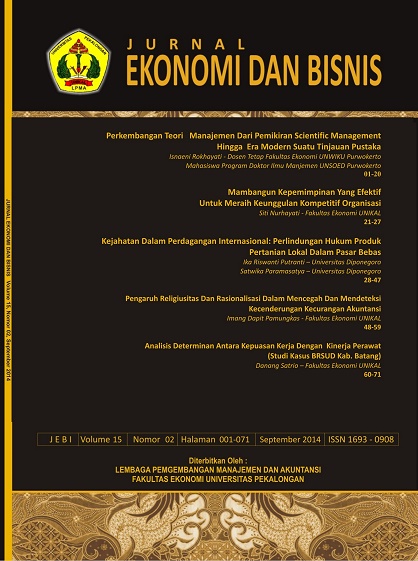
PENGARUH RELIGIUSITAS DAN RASIONALISASI DALAM MENCEGAH DAN MENDETEKSI KECENDERUNGAN KECURANGAN AKUNTANSI
DOI:
https://doi.org/10.31941/jebi.v15i2.229Abstract
This study focuses on prevention, kareena prevention is preventive measures that need to be done before the fraud occurs and can minimize the risks. This research will discuss about the determinants or fraud prevention measures, in particular the accounting fraud. The variables used in this study is religiosity, rationalization to be tested against the tendency of accounting fraud.
The population in this study were all final year accounting students s1 2012 University of Pekalongan force that has taken 120 semester credit system for the generation of students has undergone a process of learning and has got the maximum benefit from the teaching of accounting. The sample in this study were students s1, 6th semester study program Accounting University of Pekalongan.
Methods of data collection in this study using a survey method. This study uses the path analysis is used to analyze the pattern of relationships between variables in order to determine the influence directly or indirectly the independent variables (exogenous) on the dependent variable (endogenous). Benefits of path analysis is for an explanation of the phenomenon being studied or problems studied. The results of this study indicate that the first hypothesis Religiosity negatively affect acceptable rationalization, the second hypothesis Religiosity negative effect on the tendency of Accounting Fraud acceptable and third hypotheses Religiosity effect on the tendency of Accounting Fraud by Rationalization unacceptable.
Keywords: Religiosity, Rationalization, Accounting Fraud Trends
References
Albrecht, W. 2002. Fraud Examination. Mason, OH: Thomson-South Western
Allport, G. W. dan Ross, J. M. 1967. “Personal Religious Orientation and Prejudice”. Journal of Personality and Social Psychology. 5. Hal. 432-443
Alison. 2006. “Fraud Auditing.” http://www.reindo.co.id. Diakses tanggal 13 Agustus 2014
Arens, Alvin A,Elder R.J.A, Beasley M.S dan Jusuf A.A . 2003. Jasa Audit dan Assurance Pendekatan Terpadu (Adaptasi Indonesia).Jakarta:Salemba Empat.
Associaton of Certified Fraud Examiners (ACFE). 2014. Report to the Nations on Occupational Fraud and Abuse, 2014 Global Fraud Study, (Online), (http://www.acfe.com, diakses 26 Juni 2014).
Beasley, M.S. 2003. An Empirical Analysis of the Relation between the Board of Director Composition and Financial Statement Fraud. The Accounting Review71 (October): 443–465.
Brigham, Eguene . F dan Joel F. Houston. 2003. Dasar-Dasar Manajemen Keuangan. Jakarta : Salemba Empat
Brown, D.M., and Annis, L. 1978. “Moral Development Level And Religious Behavior” .Psychological Reports. 43. Hal. 1230
Committee of Sponsoring Organizations of the Treadway Commission. 2004. Guidance on Monitoring Internal Control Systems: AICPA
Cressey, D. (1953). Other people’s money, dalam: “The Internal Auditor as Fraud buster, Hillison, William. Et. Al. 1999. Managerial Auditing Journal, MCB University Press, 14/7:351 362
Ghozali, Imam. 2006. Aplikasi Analisis Multivariate Dengan Program SPSS. Badan Penerbit Universitas Diponegoro, Semarang
Glock, C. Y., & Stark, R. 1965. Religion and society in tension. Chicago: Rand McNally.
Hasnan, 2006. Management Predisposition, Motive, Opportunity, and Earnings Management for Fraudulent Financial Reporting in Malaysia. Journal of Financial Economics
Hood, R. W., Jr., Spilka, B., Hunsberger, B., & Gorsuch, R. (1996). The psychology of religion: An empirical approach (2nd ed.). New York: Guilford Press.
Houghton, K,A dan Hronsky,J.F (1993). The Sharing of meaning between accounting student and member of the accounting profession. Accounting and finance 33: 137-147.
Ikatan Akuntan Indonesia. 2009. Standar Profesional Akuntan Publik. Jakarta: Salemba Empat
Razzaque, M. A. dan Hwee T.P. 2002. “Ethics and Purchasing Dilemma: A Singaporean View”. Journal of Business Ethics 35(4). Hal. 307–326.
Rest, J. 1969. “Longitudinal study of the defining issues test of moral development: A strategy for analyzing developmental change”. Developmental Psychology, 11. Hal. 738-748.
Skousen, J.C., Wright, J.C., Smith Kevin, R. 2009, “Detecting and Predicting Financial Statement Fraud: The Effectiveness of The Fraud Triangle and SAS No. 99.” Advances in Financial Economics, Vol. 13, page. 53-81
Thoyibatun, Siti, Sudarma, Made, 2009. Analisis the influence of internal control compliance and compensation system against unethical behavior and accounting fraud tendency. Simposium Nasional Akuntansi XII, Pelembang.
Tuanakotta, Theodorus M. 2010. Akuntansi Forensik dan Audit Investigatif, Lembaga Penerbit Universitas Indonesia
Wilopo. 2006. “Analisis Faktor-faktor yang berpengaruh Terhadap Kecenderungan Kecurangan
Akuntansi”. STIE Perbanas
Downloads
Issue
Section
License
Authors who publish with JEBI: Jurnal Ekonomi dan Bisnis agree to the following terms:
- Authors retain copyright and grant the JEBI: Jurnal Ekonomi dan Bisnis right of first publication with the work simultaneously licensed under Creative Commons Attribution License (CC BY 4.0) that allows others to share the work with an acknowledgment of the work's authorship and initial publication in this journal.
- Authors can enter into separate, additional contractual arrangements for the non-exclusive distribution of the published version of the work (e.g., post it to an institutional repository or edit it in a book), with an acknowledgment of its initial publication in this journal.
- Authors are permitted and encouraged to post their work online (e.g., in institutional repositories or on their website) before and during the submission process, as it can lead to productive exchanges, as well as earlier and greater citation of published work.