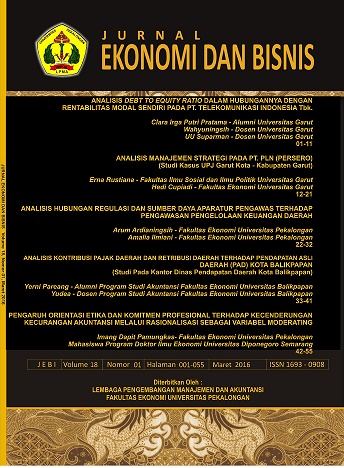
PENGARUH ORIENTASI ETIKA DAN KOMITMEN PROFESIONAL TERHADAP KECENDERUNGAN KECURANGAN AKUNTANSI MELALUI RASIONALISASI SEBAGAI VARIABEL MODERATING
DOI:
https://doi.org/10.31941/jebi.v18i1.419Abstract
This study aimed to examine the effect of ethical orientation of idealism and relativism against Fraud Trends in Accounting, Professional Commitment to Accounting Fraud Trends and Impact Orientation Ethics and Professional Commitment Accounting Fraud against the trend through Rationalization as
Moderating Variable. Sampling is purposive sample selection method used in this study. The sample in this study were 129 students S1 Accounting Pekalongan University who has taken the course of Audit
I. Hypothesis testing using multiple regression by using SPSS version 20. Results of hypothesis testing showed that idealism affect the tendency of Accounting Fraud accepted. Relativism against
Accounting Cheating tendency rejected. Professional Commitment affect the tendency of Accounting Fraud accepted. Idealism and commitment to the tendency of Professional Accounting Fraud through Rationalization as Moderating Variable accepted. However, the tendency towards relativism Accounting Fraud through Rationalization as Moderating Variable rejected.
Keywords: Ethics Orientation, Professional Commitment, Accounting Fraud Trends, Rationalization
Downloads
Issue
Section
License
Authors who publish with JEBI: Jurnal Ekonomi dan Bisnis agree to the following terms:
- Authors retain copyright and grant the JEBI: Jurnal Ekonomi dan Bisnis right of first publication with the work simultaneously licensed under Creative Commons Attribution License (CC BY 4.0) that allows others to share the work with an acknowledgment of the work's authorship and initial publication in this journal.
- Authors can enter into separate, additional contractual arrangements for the non-exclusive distribution of the published version of the work (e.g., post it to an institutional repository or edit it in a book), with an acknowledgment of its initial publication in this journal.
- Authors are permitted and encouraged to post their work online (e.g., in institutional repositories or on their website) before and during the submission process, as it can lead to productive exchanges, as well as earlier and greater citation of published work.