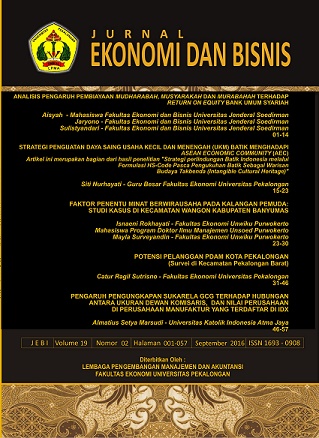
STRATEGI PENGUATAN DAYA SAING USAHA KECIL DAN MENENGAH (UKM) BATIK MENGHADAPI ASEAN ECONOMIC COMMUNITY (AEC)
DOI:
https://doi.org/10.31941/jebi.v19i2.421Abstract
This research is inspiring by the fact that Indonesian batik become to shifting market. Those shift cause of the circulation printing textile with batik motive both domestic and abroad come very
faster. On the other side, Indonesia become as member of the ASEAN Economic Community (AEC), that have the consequentcies is all of products and services must compete with all Asean state
members, so do the batik product.
The research concentrated on the centres of Indonesian batik, includes Pekalongan, Surakarta, Yogyakarta, and Bantul. The sample determinate with non probability sampling and than elected 8 companies of batik, that include on Small and Medium Enterprises (SME) , the test of data validity use the triangulasi technique.
The result of this research show that UKM batik must preparing some strategies to compete with another state members of ASEAN Economic Community (AEC). Those strategies would be conduct
to the mayor strategy namely the competitive power strategy.
Key words : ASEAN Economic Community (AEC), Small and Medium Enterprise (SME), batik,
competitive power strategy
Downloads
Issue
Section
License
Authors who publish with JEBI: Jurnal Ekonomi dan Bisnis agree to the following terms:
- Authors retain copyright and grant the JEBI: Jurnal Ekonomi dan Bisnis right of first publication with the work simultaneously licensed under Creative Commons Attribution License (CC BY 4.0) that allows others to share the work with an acknowledgment of the work's authorship and initial publication in this journal.
- Authors can enter into separate, additional contractual arrangements for the non-exclusive distribution of the published version of the work (e.g., post it to an institutional repository or edit it in a book), with an acknowledgment of its initial publication in this journal.
- Authors are permitted and encouraged to post their work online (e.g., in institutional repositories or on their website) before and during the submission process, as it can lead to productive exchanges, as well as earlier and greater citation of published work.