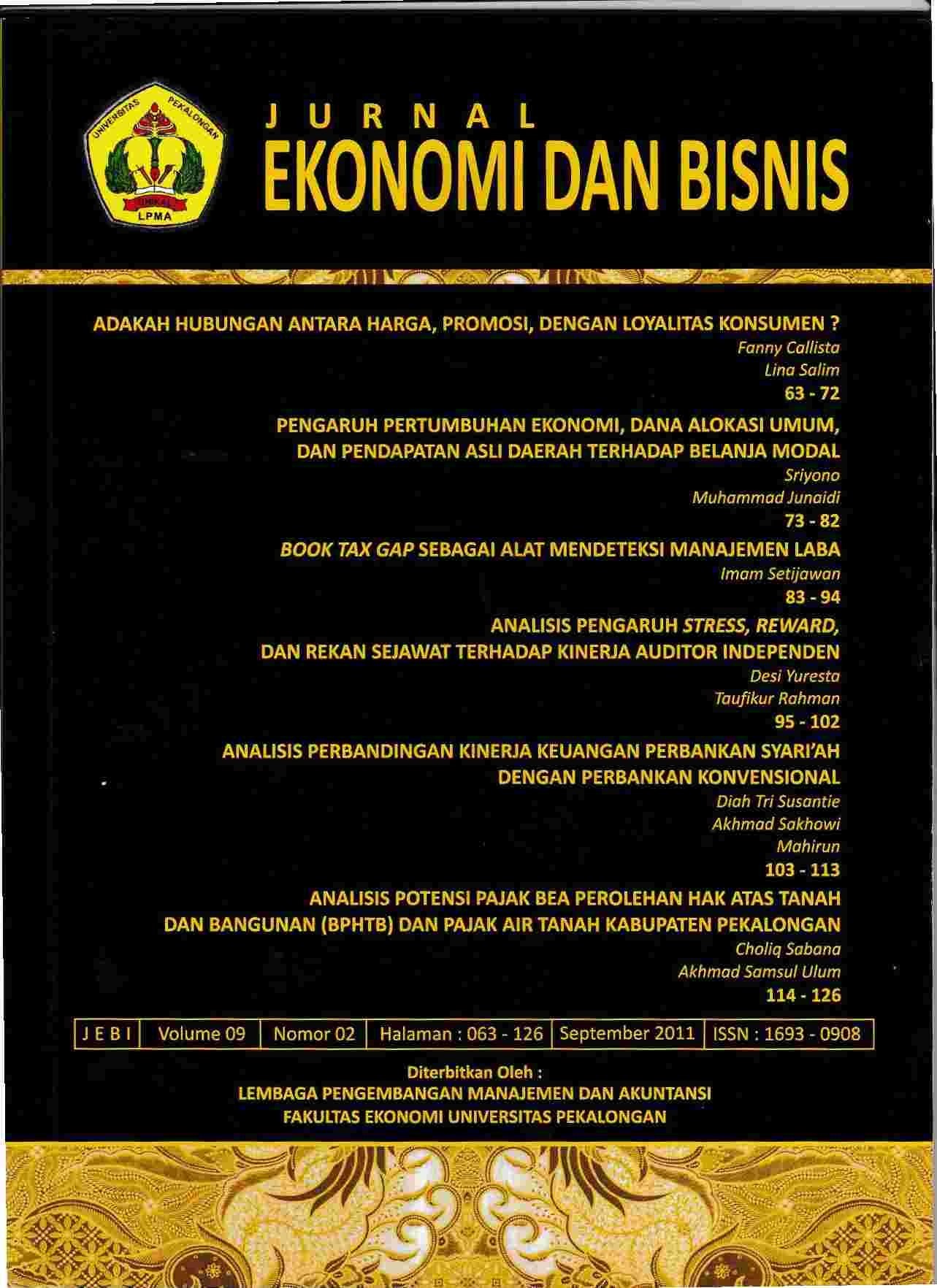
ANALISIS PERBANDINGAN KINERJA KEUANGAN PERBANKAN SYARI'AH DENGAN PERBANKAN KONVENSIONAL
DOI:
https://doi.org/10.31941/jebi.v9i2.815Abstract
This study aims to analyze the financial performance comparison between Islamic banking and conventional banking, using profitability ratios are represented by Return on Assets (ROA) as dependent variables and analyze the variables that affect the profitability of banks is Finance to Deposit Ratio (FDR), Ratio Operating costs with Revenues Operations (BOPO), Adiquasi Capital Ratio (CAR) and Reserve Elimination Receivables (PPAP).
Methods using multiple linear regression analysis, chow test and independent sample t-test (test dlff], sample uses three Islamic banks and conventional, while the data used are secondary data are reported quarterly financial reports to Bank Indonesia as well as publicized the period June 2007 - June 2010.
The results showed that in Islamic banking, CAR and PPAP no significant positive effect on ROA, LOR and no significant negative effect on ROA. BOPO significant negative effect on ROA. In conventional banking, LOR is not significant positive effect on ROA, CAR and PPAP no significant negative effect on ROA. BOPO significant negative effect on ROA. Chow test results states that there are significant differences in the influence of four independent variables on ROA in Islamic banking and conventional banking.Different test states that the ROA ratio, LOR and PPAP Islamic banking is better than conventional banking, and there are significant differences, for BOPO ratio is better than the conventional banking and Islamic banking there Is no significant difference,
Keyword : Islamic Banking, Conventional Banking, ROA, LDR, BOPO, CAR, PPAP
References
Abustan, 2009, Analisis Perbandingan Kinerja Keuangan Perbankan Syariah dengan Perbankan Konvensional ( BM! & BSM dengan
bank umum konvensional).
Ade Candra Kusuma, 2006, Ekonomi Islam : Apfikasi don Pengembangan Keilmuan di Perguruan Tinggi Agama Islam, Jurnal Hukum Islam Vol.V No.3. Juli 2006
Dendawijaya Lukman, 2005, Manajemen Perbankan,
Ghalia Indonesia, Jakarta.
Forum Ekonomi Islam Dunia (WIEF), 2009, Cegah Krisis Perkenafkan Ekonomi Syariah, Kompas, Senin 2 Maret.
Imam Ghozali, 2006, Aplikasi Analisis Multivariate dengan program SPSS, Sadan Penerbit UNDIP, Semarang.
lsna Rahmawati, 2008, Penefitian Komparasi Kinerja Keuangan Antara PT.Bank Syariah Mandiri don PT. Bank Rakyat Indonesia.
Indra Prasetyo, 2008, Anafisis kinerja keuangan bank syariah don bank konvensional di Indonesia, Jurnal Aplikasi Manajemen Vol.6/No.2. Agustus 2008.
Kasmir, 2008, Manajemen Perbankan, PT.
RajaGrafindo Persad a, Jakarta.
Mudrajat Kuncoro, 2005, Manajemen Bank Umum,
BPFE Yogyakarta.
Muhammad Syafi'i Antonio, 2004, Bank Syariah Dari
Teori Ke Praktek, Gema lnsani 2001
Rusdin, 2004, Statistik Penefitian Sebab Akibat, C.V.
Pustaka Bani Quraisy, Bandung.
Yusuf AI-Qardhawi, 2001; Bungo Bank Haram, Akbar
Media Eka Sarana, Jakarta.
Zubalr Hasan, 2005, Evaluation Banking Performance: On The Current Use of Econometric Models, Proceeding International ConferenceOn Islamic Economics and Finance
www.bi.go.id
www.bankmandiri.go.id
www.bankmega.go.id
www.bni.go.id
www.bri.go.id
www.syariahmandiri.go.id
Downloads
Published
Issue
Section
License
Authors who publish with JEBI: Jurnal Ekonomi dan Bisnis agree to the following terms:
- Authors retain copyright and grant the JEBI: Jurnal Ekonomi dan Bisnis right of first publication with the work simultaneously licensed under Creative Commons Attribution License (CC BY 4.0) that allows others to share the work with an acknowledgment of the work's authorship and initial publication in this journal.
- Authors can enter into separate, additional contractual arrangements for the non-exclusive distribution of the published version of the work (e.g., post it to an institutional repository or edit it in a book), with an acknowledgment of its initial publication in this journal.
- Authors are permitted and encouraged to post their work online (e.g., in institutional repositories or on their website) before and during the submission process, as it can lead to productive exchanges, as well as earlier and greater citation of published work.