    |
| People |
| Editorial Team |
| Reviewers |
| Contact |
| About The Journal |
| Focus and Scope |
| Peer-Review Process |
| Open Access Policy |
| Plagiarism |
| Publication Frequency |
| Submissions |
| Author Guidelines |
| Copyright Notice |
| Publication Fee |
| Template |
 |
 |
| Tools |
 |
 |
 |
| Journal Index |
 |
 |
 |
 |
 |
 |
 |
 |
 |
 |
| Visit Statistic |
About the Journal
Focus and Scope
Pena Akuatika : Jurnal Ilmiah Perikanan Dan Kelautan is a peer-reviewed and open access biannually (Maret and September). The aim of Pena Akuatika is to publish exciting, empirical research, recent science development, and high-quality science that addresses fundamental questions in fisheries and marine. All submissions must be original and not simultaneously submitted to another journal. We publish three categories of papers; original research papers, critical review articles, and short communications on applied or scientific research relevant to freshwater, brackish and marine environments.
The scope of this journal includes, but is not limited to the research results of:
- Aquaculture
- Fish Diseases
- Marine science
- Oceanography
- Aquatic resources management
- Fisheries product technology
- Fish capture technology
- Fishery agribusiness
- Fishery biotechnology/Molecular Genetics, and
- Fish health management.
Peer Review Process
All manuscripts received by Pena Akuatika : Jurnal Ilmiah Perikanan Dan Kelautan will be peer-reviewed by at least two reviewers via Open Journal System (OJS) based on the originality, contribution to the field of the scientific area, coherence of the analysis, grammar, and style. This journal uses the framework of Peer Preview Process policy, which means that both the reviewer and author identities are concealed from the reviewers, and vice versa, throughout the review process. The final decision on the acceptability, or otherwise, of manuscripts will be taken by the editor-in-chief based on reviewers' comments presented during an editorial board meeting. Scanning for instances of plagiarism present in manuscripts will be conducted by means of Turnitin software. In each manuscript, peer reviewer will be rated from the substantial and technical aspects. Peer reviewer that collaboration with Pena Akuatika is the experts in science of fisheries and marine. They were experienced in the prestigious journal management and publication that was spread around the national and International.
The editor or editorial board considers the feedback provided by the peer reviewers and arrives at a decision. The following are the most common decisions:
- accept without any changes (acceptance): the journal will publish the paper in its original form
- accept with minor revisions (acceptance): the journal will publish the paper and asks the author to make small corrections
- accept after major revisions (conditional acceptance ): the journal will publish the paper provided the authors make the changes suggested by the reviewers and/or editors
- revise and resubmit (conditional rejection): the journal is willing to reconsider the paper in another round of decision making after the authors make major changes
- reject the paper (outright rejection): the journal will not publish the paper or reconsider it even if the authors make major revisions
The reviewer’s decision will be considered by the Board of Editors to determine the ensuing process of the manuscript.
- Revision Stage. Once the manuscript has been received with notations of minor or major revisions, it will be returned to the author with a review summary form. For manuscripts accepted with major revisions, authors are allotted 3-6 weeks to revise. Whereas for manuscripts accepted with minor revisions, 1 week is allotted for revision.
- Final decision. At this stage, the manuscript will be re-evaluated by the Board of Editors to ensure that the author has revised in response to the reviewers’ concerns. In this final decision, the manuscript may still be rejected if the author did not seriously conduct the revisions necessary.
- Proofread. Once the manuscript has been deemed acceptable by the Board of Editors, it will undergo a proofreading process to maintain linguistic quality.
- Publication confirmation. At this stage, the final layout of the manuscript will be resent to the author to ensure that the content is in accordance with the author’s writing. At this stage, the author may revise any typographical error found in the final manuscript. Once confirmation from the author is given, the Editor will process the manuscript for online publication on the website as well as print publication. The author(s) will receive the final version of the manuscript as a PDF file. PROOF of all manuscripts will be provided to the corresponding author. The PROOF should be read carefully, checked against the typed manuscript, and the corrections may be returned within 7 days.
- Rejection confirmation. If manuscript is rejected, the author will be notified by Chief Editor with a statement of reasons for rejection. The author may appeal to Chief Editor if he or she believes an unfair judgement has been made which encloses the author’s reasons. Chief Editor will review and discuss the reasons with Section Editors responsible for the manuscript, and later decide whether to accept or deny the appeal.
- Copyright of manuscripts. Authors submitting manuscripts should understand and agree that copyright of manuscripts of the article shall be assigned/transferred to by Pena Akuatika : Jurnal Ilmiah Perikanan Dan Kelautan Journal. The statement to release the copyright to Pena Akuatika: Jurnal Ilmiah Perikanan Dan Kelautan Journal is stated in author's declaration Form. This work is licensed under a Creative Commons Attribution-ShareAlike 4.0 International License (CC BY-SA) where Authors and Readers can copy and redistribute the material in any medium or format, as well as remix, transform, and build upon the material for any purpose, but they must give appropriate credit (cite to the article or content), provide a link to the license, and indicate if changes were made. If you remix, transform, or build upon the material, you must distribute your contributions under the same license as the original.
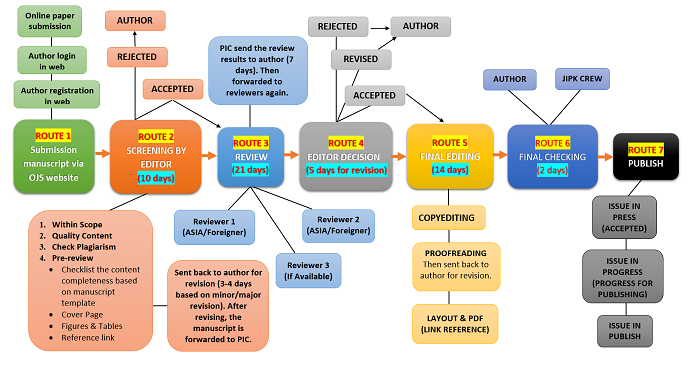
Detailed information about the flow for the manuscript submission (author) to the acceptance by the editor is shown in the following figure.
Publication Frequency
The journal is published twice a year, in Maret and September.
Open Access Policy
This journal provides immediate open access to its content on the principle that making research freely available to the public supports a greater global exchange of knowledge.

This work is licensed under a Creative Commons Attribution-NonCommercial-ShareAlike 4.0 International License.
Plagiarism Screening
Plagiarism is the act of when one author uses another work/author (copying someone’s prior ideas, processes, results or words) without permission, credit, or acknowledgment. The Pena Akuatika is strictly against any unethical act of copying or plagiarism in any form. Authors should ensure that they have written entirely original works. Pena Akuatika: Jurnal Ilmiah Perikanan dan Kelautan considers plagiarism as a serious offense and will blacklist authors who knowingly cite or use material from other published works without proper acknowledgment. Authors are recommended to use plagiarism checking program to check the similarity from prior publication before undergoing the review processes or before published. Every manuscript that is also submitted to this journal will be screened for plagiarism using Turnitin Program before submission or published by Pena Akuatika Editor
The following types of plagiarism are considered by Pena Akuatika:
1. Full Plagiarism: Previously published content without any changes to the text, idea and grammar is considered as full plagiarism. It involves presenting exact text from a source as one’s own.
2. Partial Plagiarism: If content is a mixture from multiple different sources, where the author has extensively rephrased text, then it is known as partial plagiarism.
3. Self-Plagiarism: When an author reuses complete or portions of their pre-published research, then it is known as self-plagiarism. Complete self-plagiarism is a case when an author republishes their own previously published work in a new journal.
If plagiarism is detected by the editorial board member, reviewer, editor etc., in any stage of article process- before or after acceptance, during editing or at a page proof stage. We will alert the same to the author(s) and will ask them to rewrite the content or to cite the references from where the content has been taken. If more than 30% of the paper is plagiarized- the article may be rejected and the same is notified to the author.
If plagiarism is detected after publication, the Journals will conduct an investigation. If plagiarism is found, the competent authority of the Pena Akuatika Journal will contact the author's institute and funding agencies. The paper containing the plagiarism will be marked on each page of the PDF. Depending on the extent of the plagiarism, the paper may also be formally retracted.
Author Fees
This journal charges the following author fees.
Article Submission: 0.00 (IDR)
Authors are required to pay an Article Submission Fee as part of the submission process to contribute to review costs.
Fast-Track Review: 0.00 (IDR)
With the payment of this fee, the review, editorial decision, and author notification on this manuscript is guaranteed to take place within 4 weeks.
Article Publication: 400.000 (IDR)
If this paper is accepted for publication, you will be asked to pay an Article Publication Fee to cover publications costs.
If you do not have funds to pay such fees, you will have an opportunity to waive each fee. We do not want fees to prevent the publication of worthy work.
Journal History
Pena Akuatika: Jurnal Ilmiah Perikanan dan Kelautan was the first time established in early 2007 using the name "Pena Akuatika: Jurnal Ilmiah Perikanan dan Kelautan", under Prody of Aquaculture, Faculty of Fisheries, Pekalongan University which was fully published and accessible on the website or online accessibility.
Pena Akuatika: Jurnal Ilmiah Perikanan dan Kelautan has been accredited as a 5nd Grade Scientific Journal (Sinta 5, Peringkat 5) by the Ministry of Research, Technology, and Higher Education of Indonesia since Volume 17 No. 1 Year 2018 until Volume 21 No. 2 Year 2022 with Accreditation Number 85/M/KPT/2020.