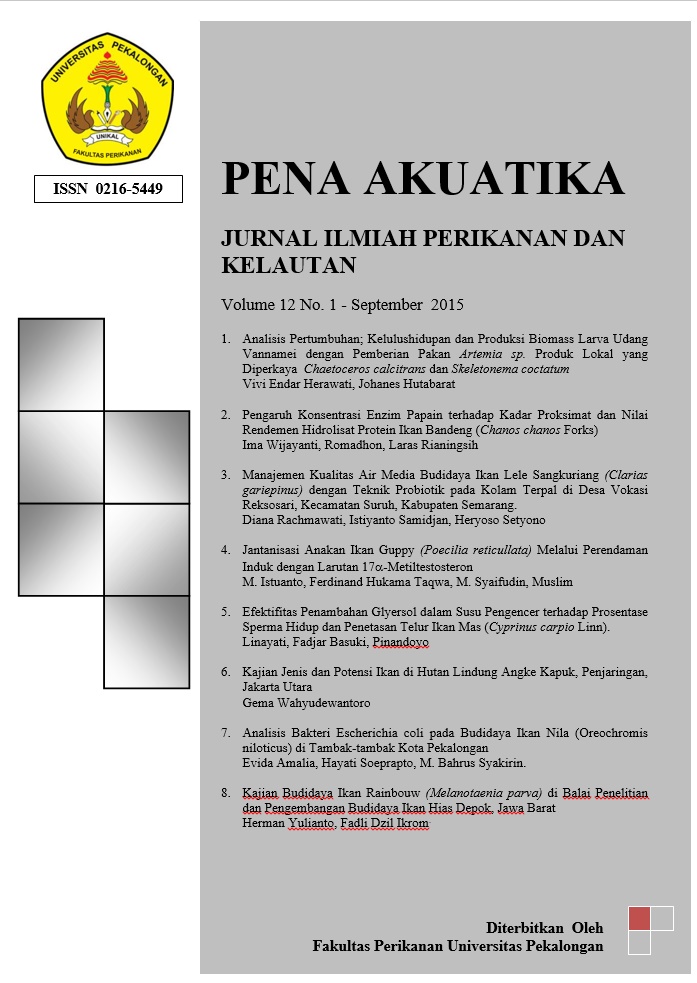
1. Analisis Pertumbuhan; Kelulushidupan dan Produksi Biomass Larva Udang Vannamei dengan Pemberian Pakan Artemia sp. Produk Lokal yang Diperkaya Chaetoceros calcitrans dan Skeletonema coctatum
DOI:
https://doi.org/10.31941/penaakuatika.v12i1.322Abstract
Natural food is the best food for fish because the nutrient cannot be replaced by artificial food. Artemia is one of the best available live food for larvae shrimp (L. vannamei), it is due to Artemia has a good nutrient for larvae shrimp. The purpose of the study is to the influence of the growth, survival and biomass weight through feeding larval shrimp Artemia sp. local products fortified). Tested animals that used were larvae of shrimp with average stages PL1-PL10, this study was conducted by using completely randomized experimental design with 4 treatments and 3 replicates. The results showed that there were significant effects (P<0.05) on biomass of shrimp larvae fed by Artemia sp. local products enriched by diatom, which the Artemia sp. local products fed by C.calcitrans and S.costatum is the best treatment with 5.84±0.6%; for biomass and showed that there were significant effect (P<0.05) on biomassof shrimp larvae fed by Artemia sp. local products enriched by diatom is 5,93±0,12 gr and 87,62 ± 2,52%. For highest survival rate showed that there were significant effects (P<0.05) on biomass of shrimp larvae fed by Artemia sp. local products enriched by diatom with the highest biomass of shrimp larvae fed by Artemia sp. Local products fed by C.calcitrans and S.costatum
Keywords : Local Artemia sp.; Growth; Survival rate; Biomass; Vannamei larvae; Diatom
References
Coyle, L. a. Bright, D. R. Wood, R. S. Neal, J. H. Tidwel. 2013. Performance of Pacific White Shrimp, Reared in Zero Exchange Tank System Exposed to Different Light Sources and Intensities. J. World. Aquat. Scienc. 44(6): 687-695.
Gallardo, G. Martinez, G. Palomino, A. Paredes, G. Gaxiola, G. Cuzon, R. P. Islas. 2013. Replacement of Artemia franciscana Naupli by Microencapsulated Diets: Effect on Development, Digestive Enzymes and Body Consumption of White Shrimp Larvae. J.World. Aquat. Scienc. 44 (2): 187-197.
Herawati E., J. Hutabarat, S. B. Prayitno. 2012. The Effect of Essential Amino Acid Profile, Fatty Acid Profile and To Growth of Skeletonema costatum using Technical Media Culture Guillard and Double Walne. J. Coast Development. 10(1): 48-54.
Herawati V.E., J. Hutabarat, S. B. Prayitno, O. K. Radjasa, Y.S. Darmanto. 2013. The Profile Essential Amino Acid, Fatty Acid and The Growth of Chaetoceros gracilis Using Technical Media Culture Guillard and Double Walne. Prosiding. FFTC-NTOU Joint International Seminar on Integrating of Promissing Technology for Aquaculture and Fisheries. 50-56 pp.
Herawati V.E., J. Hutabarat, Ocky Karna Radjasa. 2014. Nutritional Content of Artemia sp. Fed with Chaetoceros calcitrans and Skeletonema costatum. Hayati Journal of Biosciences 21(4): 121-128.
Herawati V.E, Johannes Hutabarat. 2014. Pengaruh Pemberian Pakan Larva Udang Dengan Artemia sp. Produk Impor dan Lokal Terhadap Pertumbuhan dan Kelulushidupan Larva Udang Vanname. (Prosiding . Seminar Nasional IX Hang Tuah. Surabaya
Hoa, V. N., Anh, T. T., Thi, N. A. and T. H Tnanh., 2011. Artemia fransiscana Kellong, Production in Earthen Pond : Improved Culture Techniques. College of Aquaculture and Fisheries. Cantho University. Vietnam. J. Artemia. Biol. 41 (5) : 13 – 28.
Hutabarat. J., 1999. Foods and Feeding Strategics In Rearing Shrimp Penaeus monodon Larvae. Diponegoro University. 24 pp.
Lara-Aquiano, H. M. Esparza-Leal, J. C. Sainz-Hernandez, J. T. Ponce-Palatox, W. Valenzuela-Quinones, J. P. Apun-Molina, M. G. Klanran. 2013. Effect of Inorganic and Organic on Physocochemical Parameters, Bacteria Concentration and Shrimp Growth in Litopenaeus vannamei cultures with Zero Water Exchange. J. World. Aquat. Scienc. 44 (4): 499-510.
Maciel, M. B. New, Wagner. 2012. The Predation of Artemia Naupli by The Larvae of The Amazone (Heller, 1862) is Affected by Prey Density Time of Day and Ontogenic Development. J. World. Aquat. Scienc. 43 (6): 659-669.
Mai, Q. Shao, Zirong Xu, Fan Zhou. 2013. Effect of Dietary n-3 Highly Unsaturated Fatty Acids on Growth, Body Composition and Fatty acid Profiles of Juvenile Black Seabream Acanthopagisus schleheli (Bleeker). J. World. Aquat. Scienc. 44 (3): 311-325
Mintarso., Y. 2007. Timing Evaluation of Salinity Improvement In Quality Production Artemia Cysts. [Thesis]. Masters Program in Coastal Resources Management. Universitas Diponegoro. Semarang. 18 – 20.
New., M. 1987. Feed and Feeding of Fish and Shrimp. United Nations Development Progamme Food and Agriculture Organization of United Nations. Rome.275 pp.
Nimrat. P. Tanutpongpalin, K. Sritunya, T. Boontha. 2013. Enchancement of Growth Performance, Digestive Enzyme Activities and Disease Resistance in Black Tiger Shrimp (Penaeus monodon) Post larvae by Potential Probiotics. J. Aquat. Int. 21(3): 655-666.
Perez- Velazquez, M. L. Gonzales-Felix, D. A. Davis, L. A. Roy, X. Zhu. 2013. Studies of Thermal and Haline Infleunces on Growth and Survival Rate of Litopennaeus vannamei and Litopennaeus setiferus. J. World. Aquat. Scienc. 44 (2): 187-197.
Portella, R. Takatta, N. J. Leitao, O. C. Menassi, K. Kwasek, K. Dabrowski. 2013. Free Amino Acids in Pacu, Piaractus mesopotamicus Eggs and Larvae. J. World. Aquat. Scienc. 44(3): 425-434.
Sorgeloos L. 1999. Manual on the production and use of live food for Aquaculture. FAO. Rome. Rome Univ Pr.
Usman, B. Irawan, Agus Soegianto. 2013. Effect of Lead on Survival, Osmoregulation and Histological Changes of The Gills of The White Shrimp Litopennaeus vannamei, Boone, 1931. J. Aquat. Int. 21 (5): 987-1003.
Widiastuti R, J. Hutabarat, V.E. Herawati. 2012. Effect of Different Natural Feeding (Skeletonema costatum and Chaetoceros gracilis) Absolute Against Biomass Growth and Proximate Local Artemia sp. Product. [Skripsi]. Semarang. Diponegoro University
Downloads
Issue
Section
License
1. Copyright of the article is transferred to the journal, by the knowledge of the author, whilst the moral right of the publication belongs to the author.
2. The legal formal aspect of journal publication accessibility refers to Creative Commons Atribusi-Non Commercial-Share alike (CC BY-NC-SA), (https://creativecommons.org/licenses/by-nc-sa/4.0/)
3. The articles published in the journal are open access and can be used for non-commercial purposes. Other than the aims mentioned above, the editorial board is not responsible for copyright violation