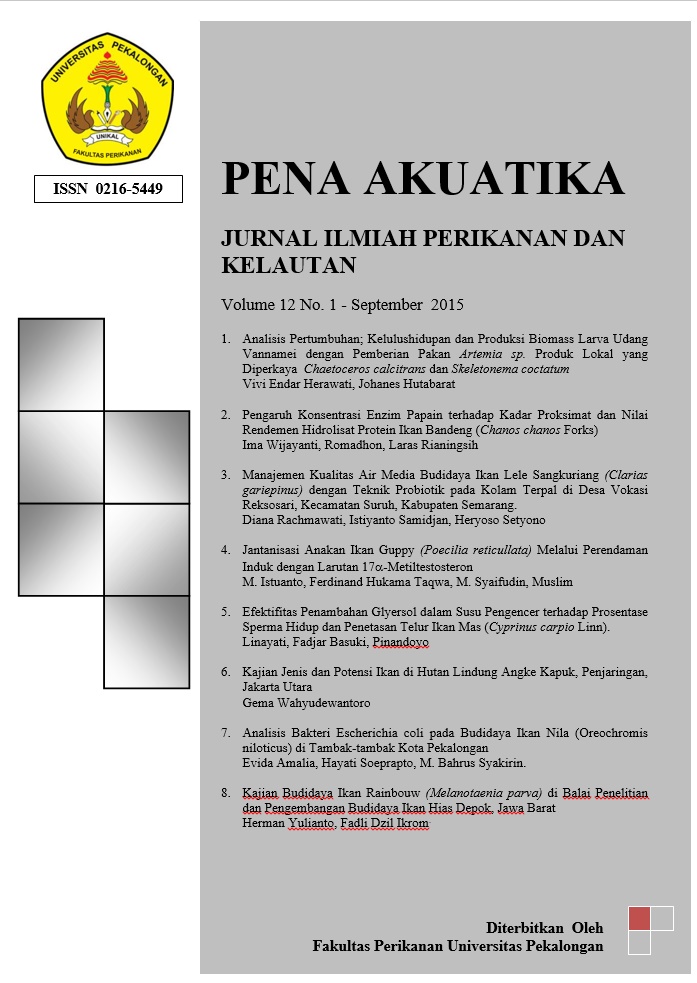
2. Pengaruh Konsentrasi Enzim Papain terhadap Kadar Proksimat dan Nilai Rendemen Hidrolisat Protein Ikan Bandeng (Chanos chanos Forks)
DOI:
https://doi.org/10.31941/penaakuatika.v12i1.323Abstrak
Milkfish with high protein content has potential as the raw material of HPI and HPI review of the fish has not been implemented. This study aims to determine the effect of the concentration of the enzyme papain to the quality of the protein hydrolyzate of fresh milkfish (Chanos Chanos Forsskal). This study was conducted laboratory experimentally. The trial design used in this study was complete random design to analyze the effect of papain enzyme concentrations (4%, 5%, and 6%) toward the quality of protein hydrolyzate of milkfish. Protein hydrolyzate of milkfish could be produced by enzymatic hydrolysis using papain enzyme. The observed parameters were the yield and the proximate level (level of protein, fat, water, and ash). Type of enzyme and concentration had significant effect toward the proximate level of protein, fat, water, and yield, but not significant toward the level of ash. The optimal condition to hydrolyze milkfish flesh into protein hydrolyzate was by using papain enzyme with concentration of 5% (b/v).
Keyword: Milkfish, hydrolyzate of protein, enzyme papain
Referensi
Abdulazees SS, Ramamoorthy B, Ponnusamy P. 2013. Proximate Analysis And Production Of Protein Hydrolysate From King Fish Of Arabian Gulf Coast - Saudi Arabia. International Journal of Pharmacy and Biological Sciences. 3(1): 138-144.
Belitz HD, Grosch W, Schieberle P. 2009. Food Chemistry. Germany: Springer- Verlag.
Ditjen Budidaya (Direktorat Jenderal Perikanan Budidaya). 2006. Rencana Strategis Perikanan Budidaya 2005-2009. Departemen Kelautan dan Perikanan, hlm 96
.
Hidayat T. 2005. Pembuatan Hidrolisat Protein dari Ikan Selar Kuning (Caranx leptolepis) dengan Menggunakan Enzim Papain. [Skripsi]. Fakultas Perikanan dan Ilmu Kelautan IPB.
Kirk RE dan Othmer DF. 1953. Encyclopedia of Chemical Technology. New York : The Interscience Publ. Inc. Volume 11.
Koesoemawardani D, Nurainy F, Hidayati S. 2011. Proses Pembuatan Hidrolisat Protein Ikan Rucah. Jurnal Natur Indonesia 13 (3): 258-261
Kordi GM. 2009. Sukses Memproduksi Bandeng Super untuk Umpan, Ekspor dan Indukan. Jakarta: Andi, hlm 148.
Liceaga-Gesualdo, and A., Li-Chan, E.C.Y. (1999). Functional properties of fish protein hydrolysate from herring (Clupea harengus). Journal of Food Science, 64(6): 1000-1004.
Pigot, G.M. and Tucker, B.W. 1990. Utility fish flesh effectively while maintaining nutritional qualities. Seafood Effects of Technology on Nutrition. New York : Marcel Decker, Inc.
Purbasari, D. 2008. Produksi dan Karakterisasi Hidrolisat Protein dari Kerang Mas Ngur (Atactodea striata). [Skripsi]. Fakultas Perikanan dan Ilmu Kelautan IPB.
Saparinto, Cahyo. 2007. Membuat Aneka Olahan Bandeng. Jakarta. Penebar Swadaya
Shahidi F dan Botta JR. 1994. Seafood: Chemistry, Processing Technology and Quality. Glasgow: Blackie Academic and Professsional.
Shahidi F, Han XQ, Synowiecki J. 1995. Production and characteristics of protein hydrolysates from capelin (Mallotus villosus). Food Chem 53: 285-293.
Syahrizal FSNA. 1991. Mikrobiologi kecap ikan yang dibuat secara hidrolisis enzimatis [skripsi]. Bogor : Fakultas Teknologi Pertanian, Institut Pertanian Bogor.
Widadi IR. 2011. Pembuatan dan Karakterisasi Hidrolisat Protein dari Ikan Lele Dumbo (Clarias gariepinus) Menggunakan Enzim Papain [Skripsi]. Fakultas Perikanan dan Ilmu Kelautan IPB.
Winarno FG. 2008. Kimia Pangan dan Gizi. Bogor: M-Brio Press.
Unduhan
Terbitan
Bagian
Lisensi
1. Copyright of the article is transferred to the journal, by the knowledge of the author, whilst the moral right of the publication belongs to the author.
2. The legal formal aspect of journal publication accessibility refers to Creative Commons Atribusi-Non Commercial-Share alike (CC BY-NC-SA), (https://creativecommons.org/licenses/by-nc-sa/4.0/)
3. The articles published in the journal are open access and can be used for non-commercial purposes. Other than the aims mentioned above, the editorial board is not responsible for copyright violation