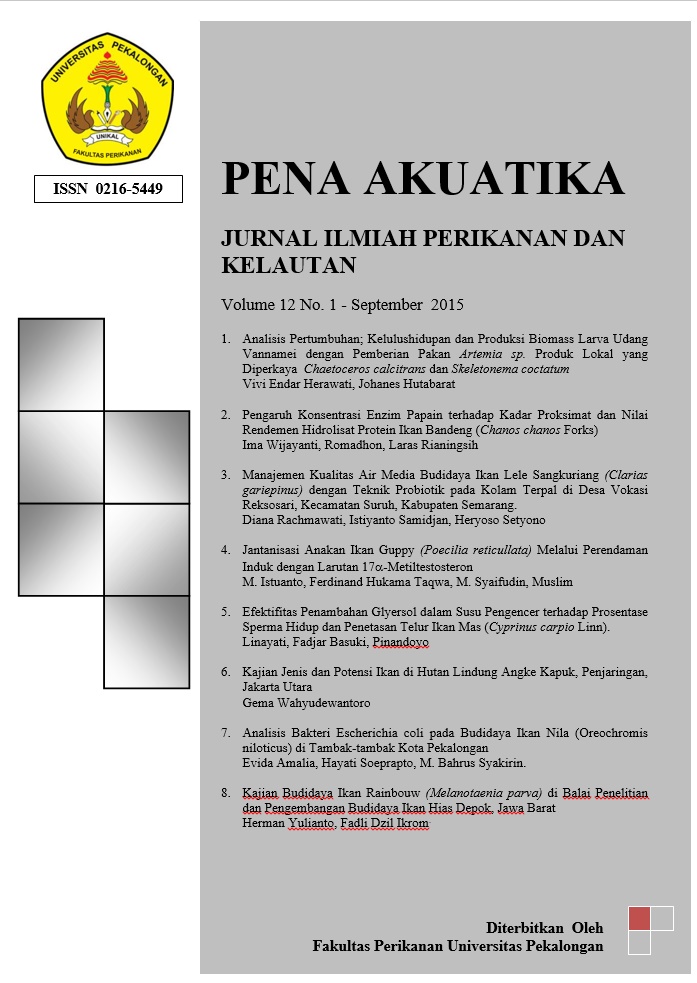
3. Manajemen Kualitas Air Media Budidaya Ikan Lele Sangkuriang (Clarias gariepinus) dengan Teknik Probiotik pada Kolam Terpal di Desa Vokasi Reksosari, Kecamatan Suruh, Kabupaten Semarang
DOI:
https://doi.org/10.31941/penaakuatika.v12i1.324Abstrak
Cultivation of Sangkuriang catfish (Clarias gariepinus) intensively can result in the decrease of quality of cultivation media water, among others the decrease of dissolved oxygen content and the increase of waste content especially organic nitrogen. The technology has been implemented to manage the activities of Sangkuriang catfish cultivation in Reksosari Vocational Sub-District, Suruh District, Semarang Regency using probiotic in cultivation media. This study aimed to compare the growth of Sangkuriang catfish raised by using probiotic and non-probiotic system cultivation media. The test animals used in this study were Sangkuriang catfish seedlings of 10 days for 500 seedlings raised for 30 days. The observation was conducted on day-0, day-15, and day-30. The observed parameters of growth were water temperature, dissolved oxygen, pH, and ammonia. The study result indicated that there was a difference in length and weight increase of Sangkuriang catfish in probiotic and non-probiotic application cultivation media. Although the increase of growth was not significant, but it could give illustration that Sangkuriang catfish raised using probiotic application experienced a better growth. It indicated that the feed given and the raising media could support the growth of Sangkuriang catfish. The raising media implementing probiotic technique showed a better and relatively ideal condition for Sangkuriang catfish.
Keyword: Sangkuriang, catfish, management, water quality, probiotics
Referensi
Avnimelech Y. & Kochba M. 2009. Evaluation of nitrogen uptake andexcretion by tilapia in bio floc tanks, using 15N tracing. Aquaculture 287:163-168.
Boyd CE. 1990. Water Quality Management in Aquaculture and Fisheries Science. Amsterdam: Elsevier Scientific Publishing Company. 3125p.
Craigh S. & Helfrich LA. 2002. Understanding Fish Nutrition, Feeds, and Feeding, Viginia Coperative Extension Service. Publication 420-256: 1-4.
Effendi MI. 2003. Biologi Perikanan. Bandung: Yayasan Pustaka Nusantara.
Ekasari J. 2008. Bioflocs technology: the effect of different carbon source, salinity and the addition of probiotics on the primary nutritional value of the bioflocs. Thesis. Faculty of Bioscience Engineering. Ghent University. Belgium.
FAO. 2007. The State of World Fisheries and Aquaculture 2006. Rome: FAO.
Gunardi B & Hafsari DR. 2008. Pengendalian Limbah Amoniak Budidaya Ikan Lele dengan Sistem Heterotrofik Menuju Sistem Akuakultur Nir-Limbah. Jurnal Riset Akuakultur 3.
Hari B, Kurup BM, Varghese JT, Schrama JW, & Verdegem MCJ. 2006. The effect of carbohydrate addition on water quality and the nitrogen budget in extensive shrimp culture sistems. Aquaculture 252, 248-263.
Kuhn, DD, Boardman GD, Lawrence AL, Marsh L, & Flick Jr. GJ. 2009. Microbial floc meal as a replacement ingredient for fish meal and soybean protein in shrimp feed. Aquaculture 296, 51-57.
Satker (Satuan Kerja) PBIAT Ngrajek. 2012. Pusat Budidaya Ikan Air Tawar. Magelang, Jawa Tengah
Schryver PD, Crab R, Defoirdt T, Boon N, & Verstraete W. 2008. The basics of bio-flocs technology: The added value for aquaculture. Aquaculture 277: 125-137.
Serfling SA. 2006. Microbial flocs: Natural treatment method supports freshwater, marine species in recirculating sistems. Global Aquaculture Advocate June 2006: 34-36.
Stickney RR. 2005. Aquaculture: An Introductory Text. Oxford: CABI Publishing, 265 p.
SNI 01-6483.4-2000 tentang Budidaya Ikan Lele. BSN. Diakses tanggal 10 Juli 2015
Taw N, Fuat J, Tarigan N, & Sidabutar K. 2008. Partial harvest/biofloc sistem promising for Pacific white shrimp. Global Aquaculture Advocate Magazine. September/October 2008: 84-86.
Unduhan
Terbitan
Bagian
Lisensi
1. Copyright of the article is transferred to the journal, by the knowledge of the author, whilst the moral right of the publication belongs to the author.
2. The legal formal aspect of journal publication accessibility refers to Creative Commons Atribusi-Non Commercial-Share alike (CC BY-NC-SA), (https://creativecommons.org/licenses/by-nc-sa/4.0/)
3. The articles published in the journal are open access and can be used for non-commercial purposes. Other than the aims mentioned above, the editorial board is not responsible for copyright violation