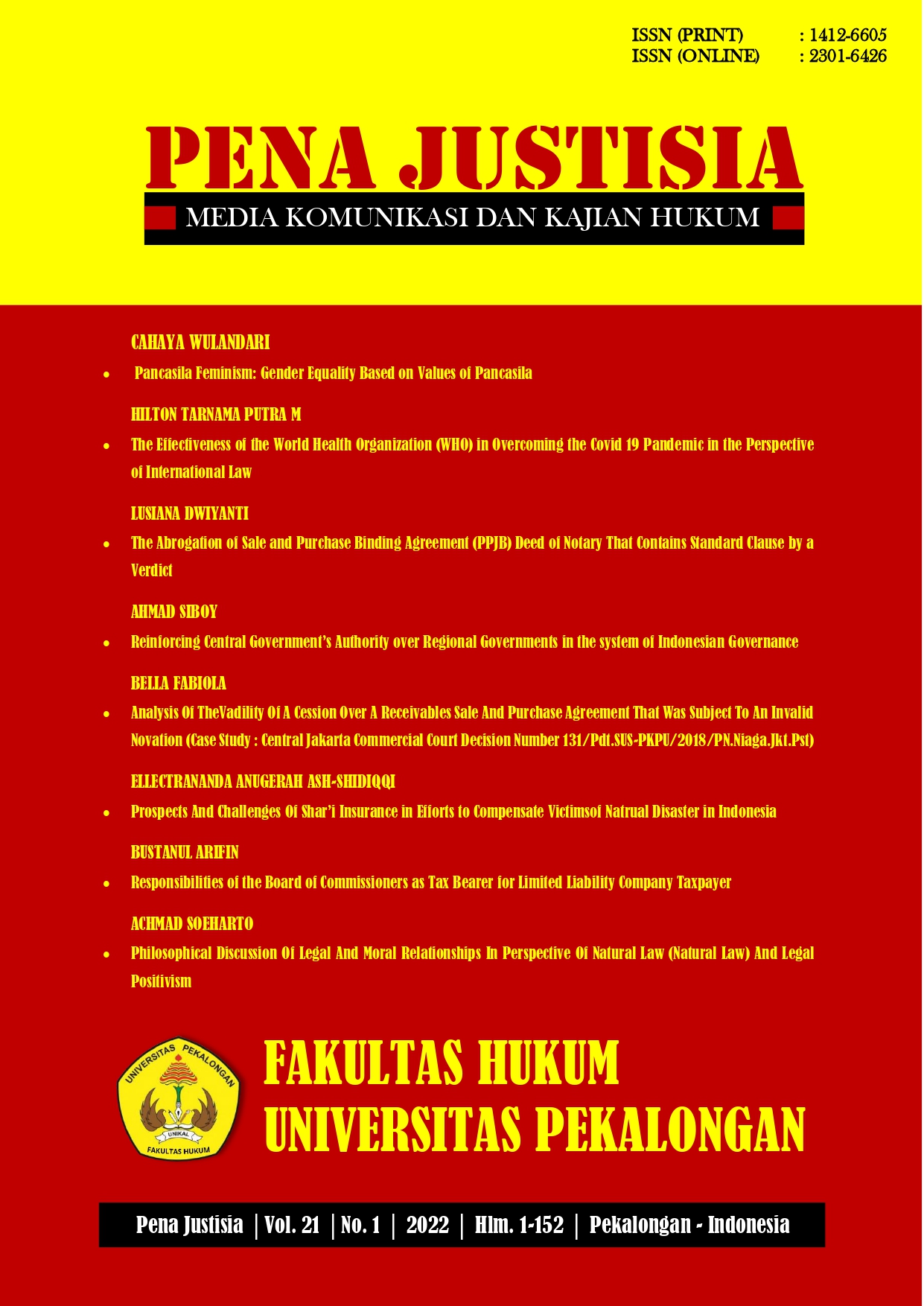
The Effectiveness of the World Health Organization (WHO) in Overcoming the Covid 19 Pandemic
DOI:
https://doi.org/10.31941/pj.v21i1.1990Abstract
The Covid 19 outbreak has caused a lot of casualties. WHO as an international organization whose goal is to achieve health at the highest level has a responsibility to mitigate the spread of the virus and its victims. The authority possessed by WHO based on international law is effective in overcoming the covid 19 pandemic. All of the categorizations to assess the effectiveness of WHO can be fulfilled by WHO while showing that WHO has succeeded in overcoming the Covid 19 pandemic.
Downloads
References
A. Le Roy Bennett, International Organizations Principles and Issues, Prentice Hall, New Jersey, 1997
Andrew T. Guzman, International Organizations and the Frankenstein Problem, The European Journal of International Law, Vol. 24 No.4, 2013
Andrew T. Guzman and Jennifer Landslide, The Myth of International Delegation, California Law Review, Vol.96, 2008
Armin von Bogdandy, Pedro A. Villarreal, International Law on Pandemic Response: A First Stocktaking in Light of Coronavirus Crisis, MPIL Research Paper No. 2020-07, 2020
Armin von Bogdandy, Pedro A. Villarreal, Critical Features of International Authority in Pandemic Response, MPIL Research Paper Series, No.2020-18, 2020.
David P. Findler, The Future of the World Health Organization: What Role for International Law, Vanderbilt Journal of Transnational Law, Vol.31, No.5, 1998
David P. Findler, Global Health Governance: Overview of the Role of International Law in Protecting and Promoting Global Public Health, Discussion Paper, WHO, Geneva, 2002.
Jacob Katz Cogan et.all, The Oxford Handbook of International Organization, Oxford University Press, UK, 2016
Jonas Tallberg, et.all., The Performance of International Organizations: An Output-Based Approach, General Conference of the ECPR, 2015
Jose E. Alvarez, International Organization: Then and Now, American Journal of International Law, Vol. 100:324, 2006.
………., International organizations as law-makers, Oxford, OUP, 2006
Kristina Duagirdas, How and Why International Law Binds International Organization, Harvard International Law Journal, Vol.57, No.2, 2016
Pedro A. Viilareal, Pandemic Declaration of the World Health Organization as an Exercise of International Public Authority: The Possible Legal Answers to Frictions Between Legitimacies, Goetingen Journal of International Law, Vol.7, No.1, 2016, p.615
Pedro A. Villarreal, Pendemic: Building A Legal Concept For the Future, Washington University Global Studies Law Review, Vol. 20, 2020.
Weinian Hu, Compulsory Licensing and Access to Future Covid-19 Vaccines, CEPS Research Report, 2020
Legal Instruments
WHO Constitution
International Health Regulations, 2005
World Health Organization, Pandemic Influenza Risk Management, WHO, Geneva, 2017
Other Sources
https://www.who.int/dg/speeches/detail/who-director-general-s-opening-remarks-at-the-media-briefing-on-covid-19---11-march-2020, accessed on April 20, 2020, at 02.00 wib
Pedro A. Villarreal, The (not-so) Hard Side of the IHR: Breaks of Legal Obligations, Global Health Law Groningen, Blog, 2020. Accessed via website https://www.rug.nl/rechten/onderzoek/expertisecentra/ghlg/blog/the-not-so-hard-side-of-the-ihr-breaches-of-legal-obligations-26-02-2020? lang=enon 22/04/2022 at 11.30 WIB.
WHO Time Line, Accessed viahttps://www.who.int/news/item/29-06-2020-covidtimelineon 22/04/2022 at 11.30 WIB
.
Downloads
Published
Issue
Section
License
Copyright (c) 2022 Hilton Tarnama PM, Belardo Prasetya Mega Jaya

This work is licensed under a Creative Commons Attribution 4.0 International License.