
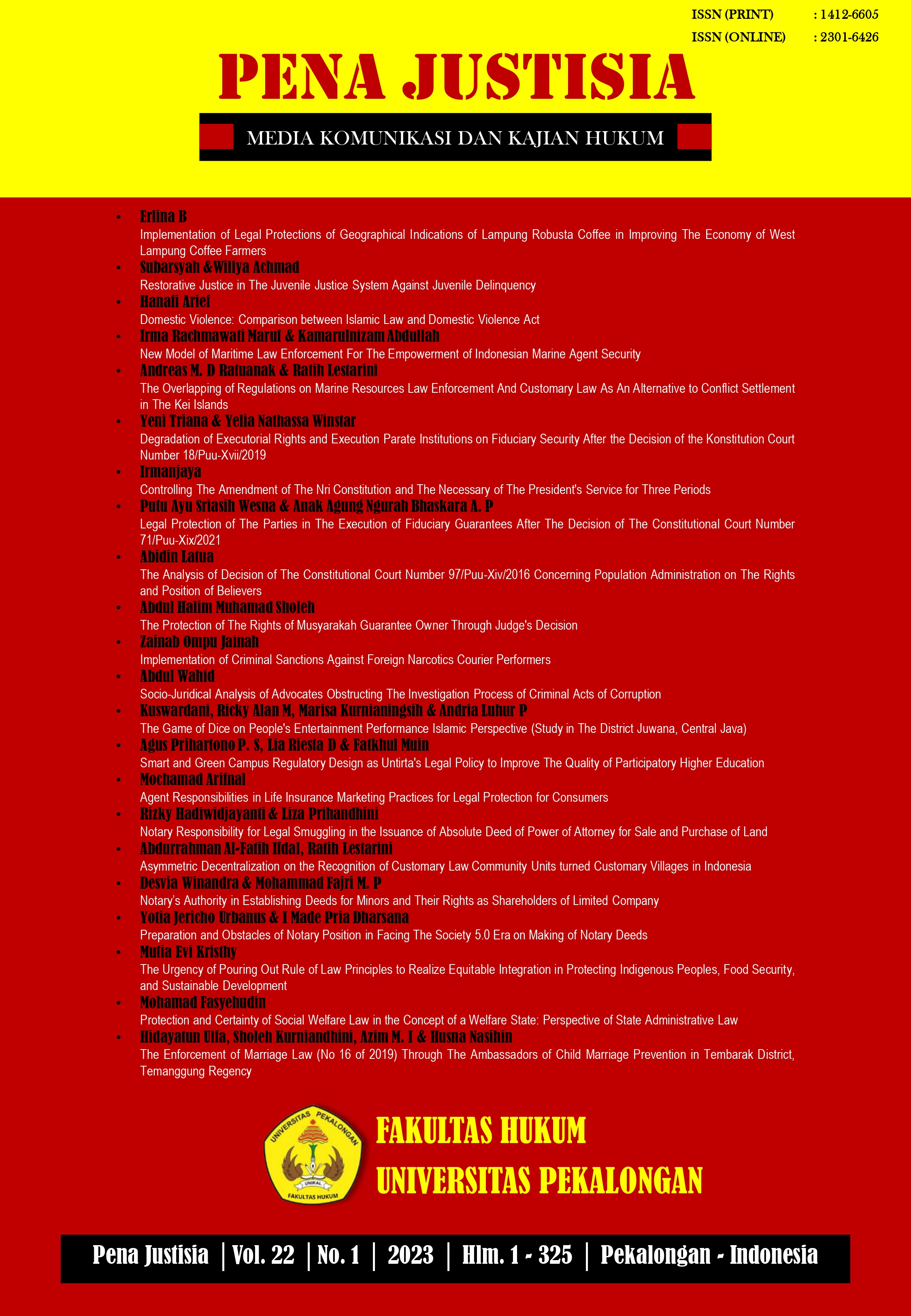
New model of maritime law enforcement for the empowerment of Indonesian marine agent security
DOI:
https://doi.org/10.31941/pj.v22i1.2245Abstract
Law enforcement is very crucial for Indonesian safety in sea maritime. In many countries, the agency enforces maritime law. Mostly of legal international trade moves by seas and is illegally used by smugglers transporting prohibited substances or illegal migrant workers. Ships are also vulnerable to violence. Ships are robbed or hijacked, raising concerns that such attacks could finance terrorism or result in seized vessels being used as floating bombs to attack essential ports. The Indonesian Government may also have a strategic policy to prevent such illegal carriage by sea. It must have harmonies of the regulations state competing interest in exploiting and regulating maritime activities. This article will seek agencies to implement law, security, and safety at sea and review marine agencies. The agents are expected to avoid law enforcement in the sea, which is currently ineffective, causing competition between authority institutions or interests, all of which are detrimental to implementing the rule of law itself. In Indonesian shipping law, law enforcement of marine law is not only be handled by one department. Some regulations give different authority to any department to force the direction. So, there is no integration system to move the marine law if the law separates the sectoral approach that caused many law problems; one of them is an overlap in authority which tends to be a conflict of interest among them. Law enforcement at sea has particular characteristics and extraordinary scopes under the applicable legal regime in the sea areaDownloads
References
Ahmad Ridwan. T Subarsyah. 2016.Politik Hukum Tata Kelola Kepelabuhan Nasional. Jakarta. Warta Bagja.
Irma Rachmawati. 2020. The legal framework of E- Document in Maritime Business Facing New NormalAfterCOVID-19Pandemic.JournalofAdvancedResearchinDynamicaland Control System. Volume 12, Issue 6, 2020. https://www.jardcs.org/abstract.php?id=5897
Rusniah Ahmad and Irma Rachmawati, 2016, Implementation of Protection and Indemnity for Indonesian Ship A Compliance to Common Law System as uploaded in http://www.serialsjournals.com/articles.php?volumesno_id=1063&journals_id =22&volumes_id=8 on 8th June 2017
Irma Rachmawati. 2019.. Marine Pollution as a weakness factor in Indonesian Ship Business Activity. Volume 11, 05 special Issue,2019. https://ww.jardcs.org
Rusniah Ahmad and Irma Rachmawati, 2016, Liability of A Sea Carrier in The Regulation Of Ship Collision Under Indonesian Maritime Law Vol 8, Issue 09. September 2016. Uploaded in https://www.journalcra.com/article/liability- sea-carrier-regulation-ship-collision-under-Indonesian-maritime-law dan https://www.journalcra.com/sites/default/files/issue-pdf/16488.pdf
Alaska Mandaraka–Sheppard. 2007. Modern Maritime Law and Risk Management, Canada. Routledge-Cavendish.
Baatz Yvonne. 2011. Maritime Law. London. Sweet & Maxwell.
Carolin Liss, 2011, Oceans of Crime, Maritime Piracy and Transnational Security in Southeast Asia and Bangladesh, Singapore, ISEAS Publisher.
Douglass Guilfoyle, 2011, Shipping Interdiction and The Law of The Sea, Cambridge, University Press.
Ellen and Campbell. 1983. International Maritime Fraud. London.Sweet & Maxwell.
Mochtar Kusumaatmadja. 2002. Right Over Natural Resources: The Indonesian Experience. Bandung. Alumni.
Norman A. Martinez Gutierrez. 2010.Limitation Of Liability in International Maritime Conventions, The relationship between global limitation conventions and Particular Liability Regimes. London. Routledge.
Robert Cribb and Michele Ford. 2009. Indonesia beyond the water's edge. Managing an Archipelagic state. Singapore. ISEAS
Downloads
Published
Issue
Section
License
Copyright (c) 2023 Irma Rachmawati Maruf, Kamarulnizam Abdullah

This work is licensed under a Creative Commons Attribution 4.0 International License.













